Disassembling and Reassembling a Wardrobe
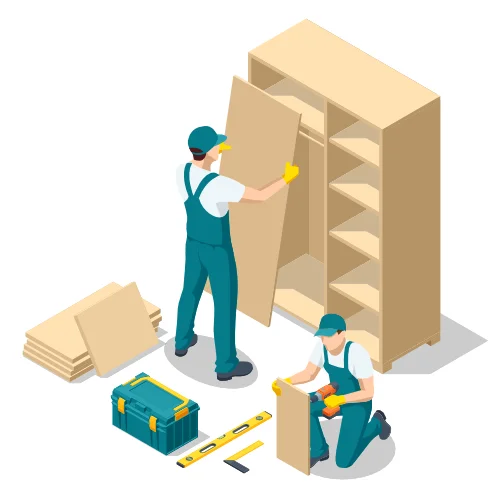
Movers assembling a wardrobe
Properly disassembling and reassembling a wardrobe takes know-how. Professional movers usually do this work alone and only occasionally have to call in someone to help in certain situations. As an amateur, you are better off doing the work as a team. Especially with modern wardrobes, which are no longer made of solid wood, it happens very quickly that the screws tear out with the wrong movements.
Disassembling a Wardrobe Systematically
The author compiled this guide himself from his many years of experience in the moving industry:
Label all parts correctly
If you want to approach the matter systematically, you start by labeling the individual parts of the wardrobe. Ideally always the same way: from left to right. To do this, stick a piece of painter's tape onto each individual wardrobe part: panels, top, bottom, moldings, etc. and number the parts from left to right. Even if certain components of the wardrobe are identical, it's worth reassembling them in the same order and not swapping parts. If the floor at the departure location has a slight slope, the individual parts can warp. If they are then reassembled in a different order, it may be that you can only level the wardrobe poorly.Helpful: If you have several similar wardrobes, each part should also be labeled with the wardrobe number. That way, the individual parts will, at the new location, again be carried into the correct room. If the wardrobe is in the living room, for example, and you want to label the second top of the wardrobe, the painter's tape could read as follows: L1 / T2 (Living Room Wardrobe 1 / Top 2)
Removing the Wardrobe Doors
The next step now is to remove the wardrobe doors. Often this is easier than it looks and can usually be done entirely without a screwdriver. However, there are very many different systems here, so only a general tip can be given: always loosen the wardrobe door at the bottom first and then at the top. Because if you loosen the door at the top first, you have to additionally hold it so that you can also loosen it at the bottom. If you loosen it at the bottom first, it still holds at the top by itself and you can simply loosen it at the top as well.Removing Shelves and Hanging Rods
Then you first remove all the internals of the wardrobe, i.e. all shelves and rods. Most of the time you can simply take these out.- Next, tape down all loose parts such as shelves and rod holders with painter's tape. That way, during assembly, you also know right away where you previously had the shelves.
The Actual Disassembly of the Wardrobe
Now comes the actual disassembly. To do this, it's best to start with the side of the wardrobe that stands free in the room. That way it's easier at the end for the last wardrobe parts on the other side to be held by the wall. Whenever possible (depending on the wardrobe system, possible for about 80% of wardrobes), you first take away the first side panel and then the top. Next the back panel and then the bottom part. And this sequence then repeats always in the same way: side panel, top, back panel, bottom. (With some wardrobe systems, the top is in 1 piece, in which case the outer side panels must be removed first and then the entire top.)Important: Transporting the Screws
The screws should be carefully collected and moved separately if possible, so not packed into a single box. Because at the new location you usually want to start reassembling the wardrobe quickly for reasons of space. If the screws are then in some random box, it is very unpleasant to first rummage through various boxes before you can begin assembling the wardrobe.
Instructions

Wardrobe assembly instructions are often puzzling
IKEA offers almost all assembly instructions for furniture online: IKEA Assembly Instructions
Packing the Wardrobe Parts
Depending on the wardrobe, it varies greatly how and whether the parts should be packed further at all. In general, however, you can say that special attention should be paid to things that protrude and can break off. Often it's also worth unscrewing such parts when this is possible. For glass and mirror doors, it's worth unscrewing the handles, because when securing them in the truck a local pressure arises at this spot and a crack or breakage can quickly occur. You must be especially careful with mirror and glass doors in which the glass goes all the way to the edge, i.e. no wooden, plastic, or metal frame runs around the glass. Because if the wardrobe doors are set on the ground during transport in the elevator, on the sidewalk, or in the vehicle and arrive with the glass on the ground, these break very quickly. For such doors, it's worth protecting the lower side with edge protectors or other protective materials, so that you can set the wardrobe doors down without risk. If you also want to play it safe, you can also completely pack all wardrobe doors, e.g. with bubble wrap or blankets. In any case, however, you must make sure that the bubble wrap or the blanket is fastened really tightly and firmly, so that the door cannot slide around loosely, so that you can carry the wardrobe door well. You can achieve this either with relatively a lot of tape or, best of all, with stretch wrap.
Even those who move with a moving company should make sure that protruding parts are handled well. It's precisely the cheap companies that often have day laborers with them, who, especially with such parts, underestimate how quickly something can get lost or break off.
Loading into the Moving Truck
When loading the wardrobes into the moving truck, a suitable area in the moving truck should first be prepared. If you have a box truck with straight, high side walls, the wardrobe can most easily be tied to one side. To do this, all the tall (long) wardrobe parts are loaded first. It's best to first take all the side parts of the wardrobe and then the wardrobe doors. Then the wardrobe can be tied down with a ratchet strap. The ratchet strap should be tightened reasonably firmly, because, due to the vibrations during the drive in the first few hundred meters, the parts still move a bit and so the tension from the fastening usually loosens a bit more.
When loading into the moving truck, it makes sense to load all parts of the same wardrobe together. That way they will surely come back together into the corresponding room at the new location. Especially when you have some very similar pieces of furniture, it can easily happen that individual parts get mixed up.
Unloading the Wardrobe
When unloading and transporting the wardrobe from the moving vehicle into the new house, the wardrobe should, if possible, already be placed in the correct room. To do this, however, the individual parts should not yet be placed against the correct wall, but ideally right against an adjacent wall next to it. That way, to assemble the wardrobe, you don't first have to move all the wardrobe parts to another location so that you have room for assembly, but can start assembling right away.
Assembling the Wardrobe
The assembly of the wardrobe can now be approached in exactly the reverse order as during disassembly. Depending on the apartment, a gap to the wall at the back of up to 5 cm should be kept, so that no mold can form on the wall and on the wardrobe. If the floor is made of parquet, you can fit the bottom parts with furniture felt, and then the wardrobe can, after setting it up (but ideally before the shelves are inside), be pushed a little more. If the floor is made of carpet, you have to position the wardrobe very precisely right from the start, because the wardrobe then usually can't be pushed at all anymore.

Professional mover assembling a wardrobe